3D Scanning & Mobile Mapping Services Oman

3D Scanning &
Mobile Mapping Services

We offer comprehensive 3D Scanning and Mobile Mapping solutions, combining the precision of Terrestrial Laser Scanning (TLS) with the speed and scale of Mobile Mapping. Utilizing the latest in stationary and vehicle-mounted LiDAR technology, our services deliver accurate, high-resolution spatial data for a wide range of applications—from detailed structural surveys to large-scale corridor mapping.

These methods are ideal for environments where traditional surveying is limited, drone access is restricted, or where ultra-high accuracy is essential.

Image

Terrestrial Laser Scanning (TLS)

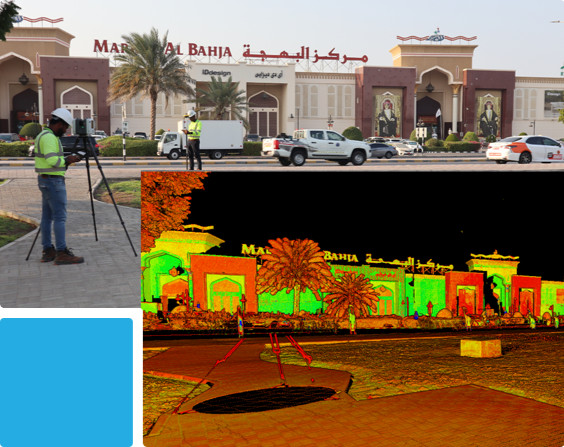
Our terrestrial laser scanning services use ground-based, tripod-mounted LiDAR systems to capture extremely accurate 3D measurements of physical spaces. We deliver precise documentation of complex structures, terrain, and industrial facilities where accuracy and fine detail are critical.

Best For:
Projects requiring millimeter to centimeter-level accuracy, such as detailed as-built documentation, BIM integration, infrastructure analysis, urban planning, heritage preservation, and corridor mapping.

Services & Deliverables:

  • Topographical & As-Built Surveys – Capture high-detail terrain data and architectural geometry for buildings, construction sites, and existing infrastructure.
  • Deformation & Alignment Analysis – Monitor the movement or structural shifts in buildings, bridges, and equipment over time using repeat scans and analytical comparisons.
  • Building Interior & Exterior Surveys – Perform high-resolution scans of both the inside and outside of commercial, residential, and industrial buildings for accurate floor plans, space analysis, and retrofitting.
  • Tankage Roundness & Verticality Surveys – Assess the structural geometry, roundness, vertical deviation, and deformation of storage tanks, ensuring compliance with design tolerances and safety standards.
  • Oil & Gas Flow Line Route Surveys – Capture precise pipeline routing information, elevation profiles, and terrain conditions for planning, inspection, or maintenance of oil and gas flow lines.
  • Refinery & Industrial Facility As-Built Surveys – Deliver comprehensive 3D documentation of complex refinery layouts and industrial plants to support redesign, expansion, clash detection, and maintenance workflows.
  • Overhead Line (OHL) Route Surveys – Map existing overhead transmission and distribution lines, towers, and right-of-way corridors for grid planning, vegetation management, and clearance analysis.

Mobile Mapping

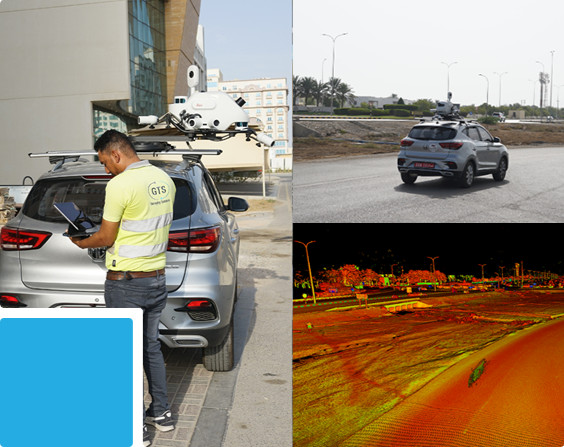
Our mobile mapping services deliver rapid, high-accuracy 3D scanning and geospatial data acquisition across extensive or linear environments. By integrating vehicle-mounted LiDAR systems with GPS and IMU sensors, we provide efficient surveying of large-scale areas—such as highways, cities, and infrastructure corridors—while maintaining exceptional spatial precision.

Best For:
Linear and wide-area projects requiring speed, scale, and consistent accuracy, including infrastructure development, utility management, and urban planning.
Services & Deliverables:

  • Topographical & As-Built Surveys – Efficiently collect high-resolution data on terrain, buildings, construction sites, and existing infrastructure across large or complex areas.
  • Large-Scale Road & Corridor Mapping – Perfect for mapping highways, rail corridors, and pipelines—capturing precise surface geometry, cross-sections, and roadside features at driving speed.
  • Asphalt Flatness & Surface Profiling – Assess pavement flatness and detect surface irregularities for quality control and maintenance planning. Provides continuous surface data for accurate assessment of ride quality and compliance with engineering standards.
  • City Modeling & Urban Planning – Produce accurate 3D models and topographic base maps to support zoning analysis, infrastructure design, and smart city initiatives.
  • Asset Inventory & Condition Assessment – Automatically detect, classify, and geolocate assets such as road signage, barriers, poles, and street furniture. Enables condition evaluation and planning for maintenance or upgrades.
Image

Frequently Asked Questions

Terrestrial Laser Scanning (TLS) uses ground-based, tripod-mounted LiDAR systems to capture extremely accurate 3D measurements of physical spaces, structures, and terrain.
TLS is ideal for projects requiring millimeter to centimeter-level accuracy, including as-built documentation, BIM integration, infrastructure analysis, urban planning, heritage preservation, and corridor mapping.
TLS can achieve millimeter-level precision, making it suitable for high-detail engineering, structural analysis, and industrial applications.
Yes, TLS is highly effective for both interior and exterior surveys, allowing seamless capture of buildings, facilities, and surrounding terrain.
Deliverables include high-density point clouds, topographical maps, as-built drawings, 3D models, deformation analysis outputs, and CAD/BIM-compatible datasets.
Deformation and alignment analysis uses repeat laser scans to detect movement, settlement, or structural shifts in buildings, bridges, tanks, and industrial equipment over time.
TLS captures detailed geometric data of storage tanks to assess roundness, vertical deviation, and deformation, ensuring compliance with design tolerances and safety standards.
TLS provides precise pipeline routing, elevation profiles, and terrain data for planning, inspection, maintenance, and upgrade of oil and gas flow lines.
Yes, TLS delivers comprehensive 3D documentation of complex refinery and industrial facilities to support redesign, expansion planning, clash detection, and maintenance workflows.
TLS accurately maps overhead transmission lines, towers, and right-of-way corridors to support clearance analysis, vegetation management, and grid planning.
Mobile mapping uses vehicle-mounted LiDAR systems integrated with GPS and IMU sensors to rapidly capture high-accuracy 3D spatial data while moving through large or linear environments.
Mobile mapping is best for highways, rail corridors, pipelines, urban environments, and utility networks where speed, scale, and consistent accuracy are required.
Mobile mapping typically delivers centimeter-level accuracy across extensive areas, making it ideal for infrastructure and corridor-level surveys.
Deliverables include point clouds, topographical and as-built maps, cross-sections, corridor models, asset inventories, and GIS/CAD-ready datasets.
It captures detailed surface geometry, cross-sections, and roadside features at driving speed, reducing traffic disruption and project timelines.
This service evaluates pavement smoothness and detects surface irregularities to support quality control, ride quality assessment, and maintenance planning.
Yes, mobile mapping produces accurate 3D city models and topographic base maps for zoning analysis, infrastructure design, and smart city initiatives.
Assets such as signage, barriers, poles, and street furniture are automatically detected, classified, geolocated, and assessed for condition and maintenance planning.
Yes, all datasets are delivered in industry-standard formats compatible with CAD, GIS, and BIM software.
Absolutely. TLS is used for high-detail, critical areas, while mobile mapping covers large or linear extents efficiently—providing complete spatial coverage.
Accuracy is ensured through calibrated sensors, GNSS control, quality checks, and rigorous data processing workflows.
Up