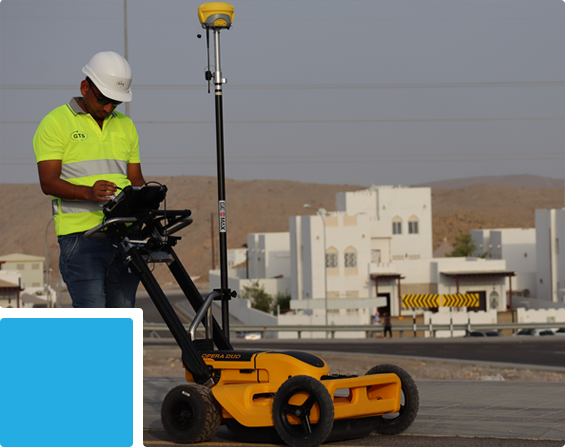
We provide comprehensive subsurface utility detection and mapping solutions using a combination of Ground Penetrating Radar (GPR), electromagnetic cable locators, and high-precision GNSS receivers. These technologies enable us to identify, trace, and map underground utilities with accuracy, efficiency, and minimal surface disruption.
Our services support a wide range of industries and applications—ensuring safe excavation, informed design, and accurate utility records for construction, infrastructure, and development projects. This approach is ideal for urban areas, brownfield sites, or any location where underground utilities—such as water pipes, electrical conduits, gas lines, telecom cables, and drainage systems—must be accurately located and documented.
Our GPR services use high-frequency electromagnetic waves to detect buried utilities and structures without excavation. This non-destructive method provides real-time imaging of subsurface features, ideal for detecting non-metallic utilities like plastic pipes and concrete ducts that may not be visible to traditional locators.
Best For:
Detecting non-metallic or unknown utilities, mapping complex underground networks, and assessing utility depths and alignments in congested or sensitive environments.
Our electromagnetic locator services provide precise tracing of metallic underground utilities. By applying a signal and detecting its electromagnetic field, we can trace the path of conductive utilities—such as electrical cables and metal pipes—ensuring accurate alignment and identification of active or abandoned services.
Best For:
Mapping buried power cables, communication lines, metallic water/gas pipes, and verifying live service lines before excavation.
Our GNSS-based utility mapping services use RTK-enabled receivers to accurately capture the geospatial coordinates of detected utilities. This ensures data is fully compatible with CAD, GIS, and BIM systems—supporting future planning, records management, and safe digging operations.
Best For:
Projects requiring spatially accurate utility records, GIS integration, or utility verification prior to design and construction.